The #1 Mistake Small Businesses Make With Their Website (and How to Fix It)
Recently, I was looking into part-time childcare for my son and kept hearing about a place in town with a really cool concept. Without naming names, they offer part-time childcare with on-site coworking for parents, which is basically a goldmine for someone with a work setup like mine.
I run my own business while also being the primary caregiver for my son during the week. I love that I get to do both, but finding uninterrupted time to actually sit down and work can be a challenge. The idea that I could drop him off for a few hours, walk down the hall, get some actual work done, and still be close by sounded pretty damn perfect. People in town had great things to say about the place too, so naturally, I went to their website to learn more.
And that's where they almost lost me.
Their website had a couple of vague paragraphs about the concept, but not much beyond that. There weren't testimonials from other parents or many photos of the classrooms. They mentioned an in-house chef and a milk bar, which sounded amazing, but what did that actually look like? What were the different childcare options? What were the rates? Who would be taking care of my son? What would his day there actually look like? I had so many questions, and instead of answering them, the website gave me more.
When the service you're considering is childcare, vague isn't exactly the feeling you're looking for. Of course, I could schedule a tour and ask everything in person, but taking that next step costs me something. I'm a new parent with limited free time, and my husband would need to step away from work so we could both attend. Scheduling a meeting just to get the basic information I was hoping to find online felt like a pretty big commitment when I wasn't even sure the place was right for us.
In marketing terms, I was a cold lead. After visiting their website, I was still cold. Maybe even a little colder.
Eventually, I took the leap and scheduled the tour anyway, and here's the kicker: they were amazing. The space was great, the people were wonderful, the concept made so much more sense once we were actually there, and their offerings were genuinely hard to beat compared to the other options we'd looked into. I left thinking, Why the hell didn't I get any of this from their website?
And because I'm a website designer with a background in UX who apparently can't go anywhere without analyzing the branding and user experience, I started wondering: how many genuinely great small businesses are accidentally sabotaging themselves online?
The business wasn't the problem. The website simply wasn't showing me how good the business actually was.
The #1 small business website mistake: treating your website like an ad
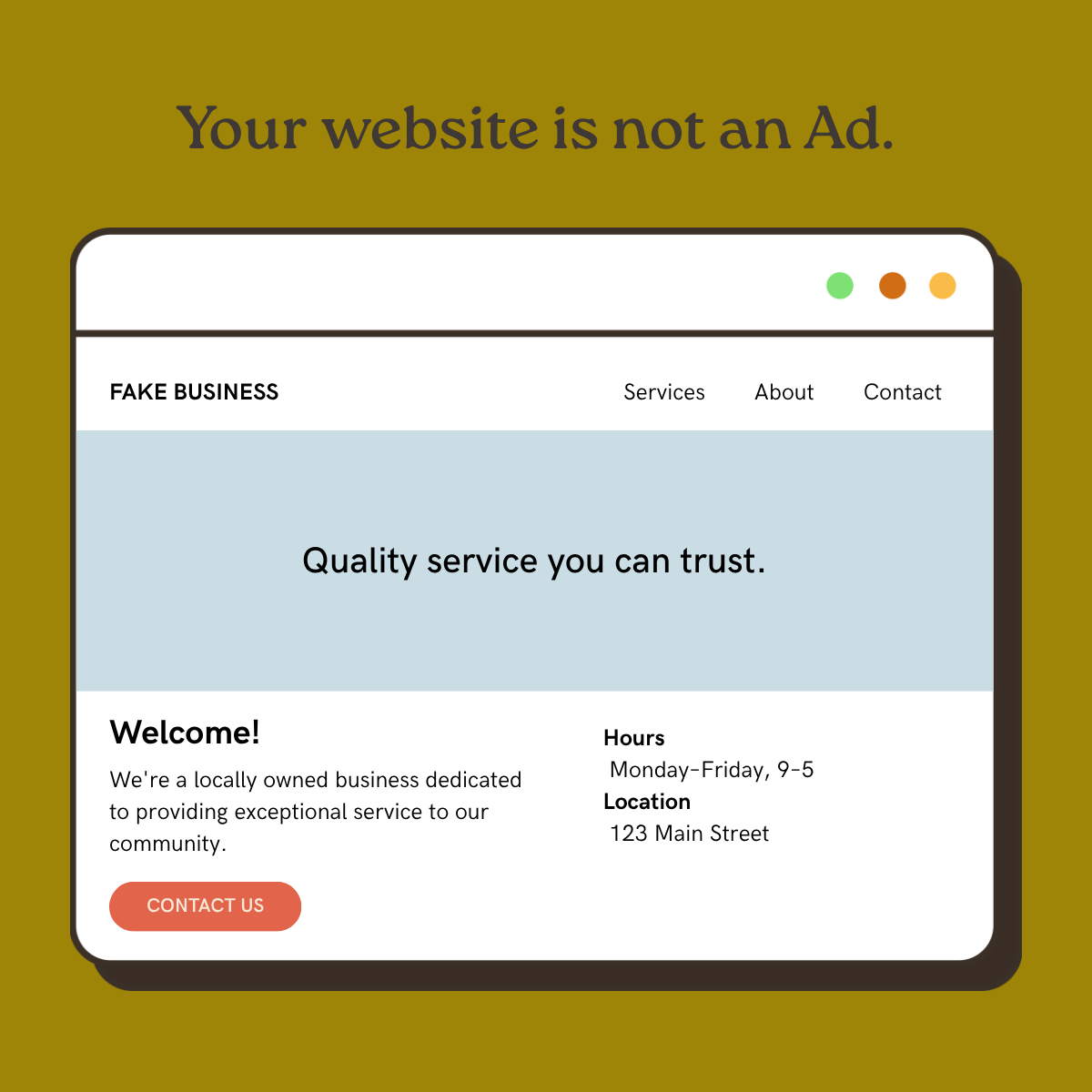
A very unhelpful website.
I see versions of this all the time with small business websites. A restaurant opens in town and I want to check it out. I hear about a new boutique and immediately Google it. I'm looking for a class, service, contractor, salon, you name it, and the first thing I do is pull up the website. So many of them basically give me a business name, a sentence or two about what they do, an address, some hours and a contact button.
That's an ad. Your website should be doing so much more than proving your business exists.
Your website should be a stand-in for you when you aren't there.
Think about what happens when a potential customer actually talks to you. You answer their questions, explain the things that make your business different and recommend the right option for what they need. They get a sense of your personality and what it might be like to work with you. You reassure them when they're hesitant and point them toward whatever their next step should be. Your website should be doing as much of that work as possible before you ever speak to them.
Someone might find your small business through a Google search at 11 p.m. while you're asleep. They might hear your name from a friend, click over from Instagram or walk past your storefront and look you up later from their couch. You aren't there to personally make the introduction, so your website has to do it for you.
A good small business website should take someone who barely knows your business exists and help them understand it, trust it, connect with it and feel comfortable taking the next step. In marketing speak, your website should turn cold visitors into warm leads. In normal-person speak, you want someone to go from Who the hell are these people? to Ohhhh. I like them.
If you're currently thinking, “Oh shit, my website doesn't do that...”
Hi. That's quite literally what I do.
I'm Bri, the designer behind Chartreuse Studio, and I design custom Squarespace websites for women-owned small businesses that need their website to do more than sit there looking pretty. My approach to small business website design starts with figuring out what your customers actually need from your website. What questions are they asking? What makes them hesitate? What makes your business different from the other seventeen tabs they have open? What do they need to see, know and feel before they're comfortable taking the next step?
Then we build a website around that.
Explore my custom Squarespace website design packages →
If you'd rather tackle it yourself, keep reading. There are a few things you can do to make your website work a hell of a lot harder for your business.
Answer the questions you're already answering
If you've answered the same question in three emails, two phone calls and an Instagram DM this week, there's a pretty good chance the answer belongs somewhere on your website. Think about the things potential customers consistently want to know before they're ready to buy: How much does it cost? What's included? How does the process work? How long does it take? Do I need an appointment? Do you serve my area? Which option is right for me? What happens after I book?
You don't need to anticipate every possible question or build an FAQ page the length of a CVS receipt. You just want to remove the little bits of uncertainty that might otherwise stop someone from moving forward.
The childcare website is a perfect example. I didn't need them to answer every hyper-specific parenting question I might eventually have. I needed enough information to decide whether scheduling a tour was worth our time. Photos of the space, information about the caregivers, pricing or even starting rates, the different enrollment options, and a better explanation of the things that made their concept unique would have made a huge difference. The goal isn't to eliminate the need for human interaction. It's to make someone want that interaction.
Show what actually makes your business worth choosing
One of the saddest things a website can do is make a really interesting business look completely generic. If you offer something your competitors don't, tell me. If customers consistently choose you for a particular reason, tell me that too. If you have an unusual process, a strong philosophy, an incredible space, a ridiculously specific specialty, or simply a personality people love, your website shouldn't hide it behind a paragraph about providing “high-quality service tailored to our customers' unique needs.”
That could describe approximately every business on planet Earth.
Your value proposition doesn't have to be a perfectly crafted corporate marketing statement. A potential customer just needs to understand what makes you different and why that difference might matter to them. Your website design should reinforce that too. Your copy, colors, typography, photography, illustrations, layout and overall branding should give someone a feeling for your business before they've read every word.
Small businesses have something giant corporations spend millions trying to manufacture: an actual personality. Use it.
Give people a reason to trust you
Someone who already knows and loves your business probably doesn't need much convincing. A stranger who just found you on Google does, and your website needs to bridge that gap.
Depending on your business, trust might come from testimonials, reviews, examples of your work, case studies, credentials, press, years of experience, recognizable clients, before-and-after photos, results, or simply showing enough of the business that someone understands there are competent humans behind it. The bigger the commitment you're asking someone to make, the more important this becomes.
If I'm deciding where to grab lunch, I probably don't need your entire life story. If I'm considering giving you thousands of dollars, inviting you into my home, trusting you with an important project or, you know, leaving my baby with you, I'm going to need a little more. Don't make potential customers hunt around the internet looking for proof that you're legit.
Show the humans behind the business
This is one of the biggest advantages small businesses have, so please stop hiding the people behind them. You don't need an About page containing your autobiography from kindergarten onward, but I should be able to figure out who owns the business, who I might be working with and why you care about what you do.
This is especially important for service businesses, where you are often part of what the customer is buying. Seeing your face, learning a little about your story, understanding your experience and getting a sense of your personality creates familiarity before someone ever reaches out. Familiarity makes contacting a stranger on the internet feel a whole lot less strange.
Connect the dots between your website and the rest of your business
Your website should be the home base of your business, but it doesn't need to be the only place someone gets to know you. If you have a physical storefront, show it to me and tell me what I need to know before I visit. If your Instagram is where you post new arrivals, send me there. If you have hundreds of glowing Google reviews, don't make me discover them by accident. If you've been featured somewhere, show it off.
The same goes for events, an online booking system, your portfolio, a newsletter or anywhere else a potential customer can learn more about you. People take different paths before they're ready to buy, so make it easy for them to keep getting to know your business instead of sending them back to Google to figure it out themselves.
And for the love of God, tell people what to do next
Once you've answered their questions, shown them what makes you different and given them a reason to trust you, don't make someone hunt through your navigation trying to figure out how to give you money.
Book a tour. Schedule a consultation. Shop the collection. Make a reservation. Request a quote. Visit the store. Start your project. Whatever the next logical step is, make it obvious and make it easy. A beautiful website that leaves someone thinking Okay...now what? isn't doing its job.
Give your small business website the cold-lead test
Here's an easy way to look at your own website differently: pretend you know absolutely nothing about your business. You haven't had a conversation with yourself. You don't know that everyone raves about that one service you barely mention. You don't know why your process is different, why your prices are higher, or what happens after someone hits “inquire.” All you have is what's on the screen.
Would you understand what the business does and what makes it different? Have your biggest questions been answered? Can you see the people behind it? Do you have a reason to trust them? Does the personality of the website match the personality of the actual business? Most importantly, do you know exactly what to do if you're interested?
Your website doesn't need to answer every possible question or close every sale. It just needs to move someone forward.
That's what the childcare website failed to do for me. Luckily, I had recommendations from people I trusted, so I took the next step anyway and discovered a business that was significantly better than its website made it seem. But not every potential customer is going to give your business that second chance, and that's the real problem.
Your website shouldn't just prove that your business exists. It should help people understand why it's worth choosing. When you aren't there to make the introduction, your website is. And it better have something good to say.