Why I Hate WordPress for Most Small Business Websites
I have a confession that may get me kicked out of the web designer club: I really don’t like WordPress for most small business websites.
It’s not because WordPress is bad. It’s an incredibly powerful platform, and for some businesses, that level of flexibility makes perfect sense. My problem is that I’ve seen way too many small businesses end up with WordPress websites that are far more complicated than they ever needed.
And this opinion is personal.
Years before I became a web designer, my dad spent way too much money having a WordPress website professionally built for his small business. Years later, I have somehow become its personal tech support. Whenever something breaks, needs updating, or randomly stops working, guess who gets the call?
Me. It is the bane of my existence.
Even as a web designer, going into a WordPress site someone else built and figuring out what the hell is going on can be a project. Which plugin controls this? Is this custom? Why did this suddenly stop working? What happens if I update it? Will fixing one thing break something else?
My dad isn’t the only small business owner I’ve seen in this situation. I’ve talked to business owners who spent thousands on websites they can no longer confidently update themselves. They’re no longer working with the original designer, they don’t have the budget to hire someone every time something needs to change, and eventually the website just stops evolving with the business.
That’s my real problem with WordPress. Sometimes we’re making a small business website way more complicated than it needs to be.
So, is WordPress good for small businesses?
It can be. I just don’t think it’s the best choice for every small business.
WordPress is incredibly flexible, but that flexibility can come with more maintenance, technical complexity, and ongoing support. If your business genuinely needs everything WordPress can do and you have the resources to maintain it, great. It may be exactly the right platform for you.
But most small business owners I work with need a website that can showcase their work, explain their services, generate inquiries, take bookings, collect payments, sell products or services, publish content, or some combination of those things.
You don’t necessarily need WordPress to do any of that.
And when you’re spending thousands of dollars on a website, I think there’s a question that matters just as much as what it can do:
What happens after your web designer hands it over?
Can you change your pricing? Add a service? Swap out photos? Add a staff member? Publish a blog post? Create a new page? Or does every change require an email to your web designer and another invoice?
A website doesn’t stop costing you money when it launches. How much it costs to own and maintain over the next several years matters too.
So, what’s a better option?
For many of the small businesses I work with, I prefer Squarespace.
Not because every business should use Squarespace, and definitely not because I think small businesses need simple, cookie-cutter websites.
I like it because I can build something completely custom and surprisingly powerful while still handing my client a website they can actually manage themselves.
I can use custom code and CSS when it adds something valuable, build booking and purchasing experiences, incorporate forms, payments, customer accounts and e-commerce, and design the entire website around how the business actually operates.
But underneath all of that is a system my client can continue using after I’m gone.
That matters to me as a UX designer. UX, or user experience design, is essentially about making things intuitive and functional for the people who actually have to use them. When I design a website, I’m thinking about the customer visiting it, but I’m also thinking about the business owner who has to manage it for years to come.
Think Squarespace can’t handle a powerful website? Check this out.
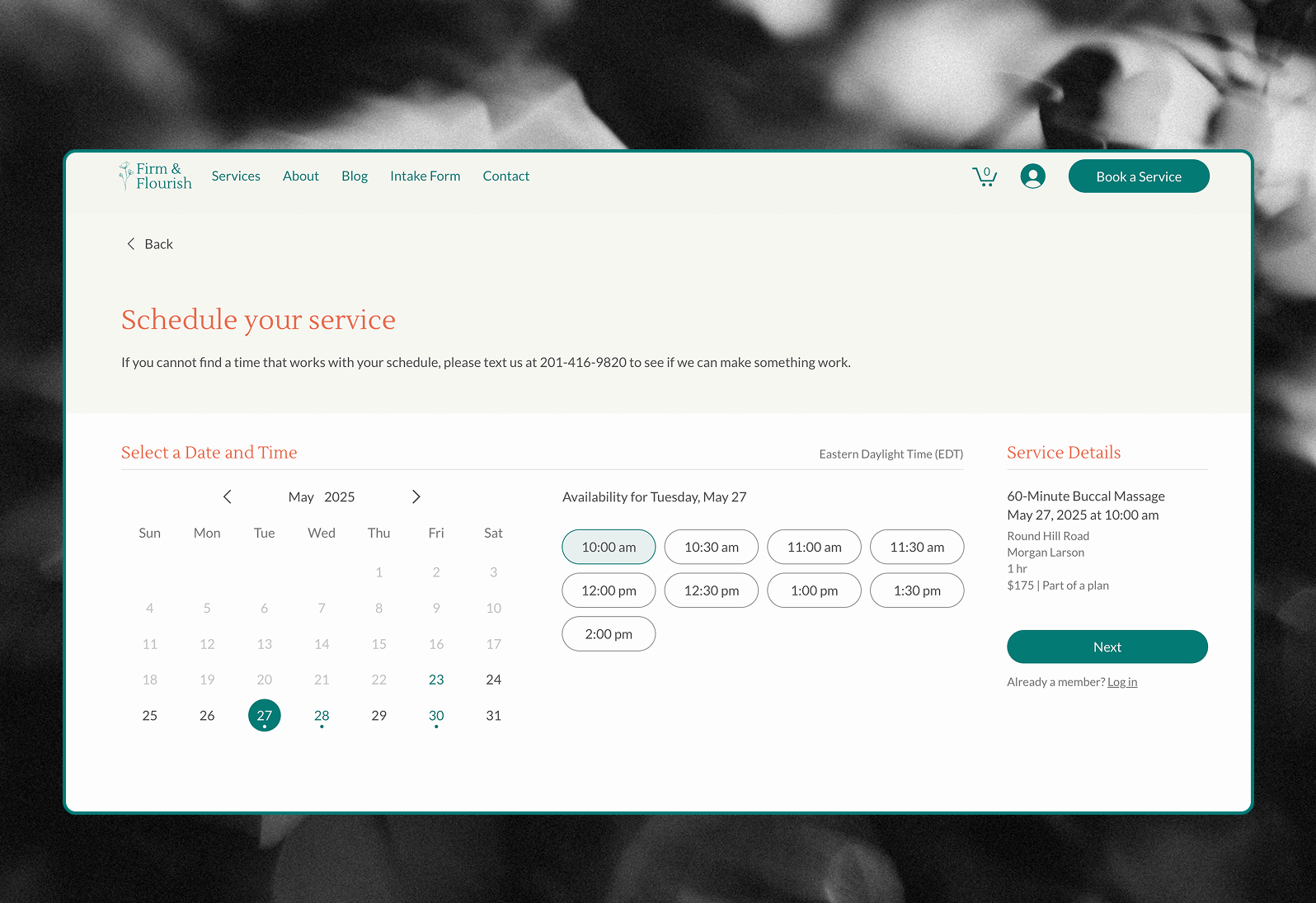
The booking page for Firm & Flourish’s website.
One of my favorite examples is a website I built for a client.
This isn’t a basic five-page website. Customers can create accounts, book services directly through the site, complete intake forms, purchase packages, and make payments, all without the business needing to depend on a separate booking platform.
On the back end, my client can add staff, update services and information, publish blog posts, create forms, add or remove pages and sections, and continue changing the website as the business grows.
And she can do all of it without me.
That was intentional.
I don’t want my clients coming back to me because they can’t change a photo or update their pricing. I want them coming back because their business is growing, they’re launching something new, or they simply want to work together again.
Need a website you can actually own?
If you’re looking for a Squarespace website designer, that’s exactly how I approach custom website design at Chartreuse Studio.
We’ll figure out what your business actually needs your website to do, build the functionality around it, and make sure you know how to manage it once it’s yours. You get a custom website designed around your business without needing to keep your web designer on speed dial for the next five years.